
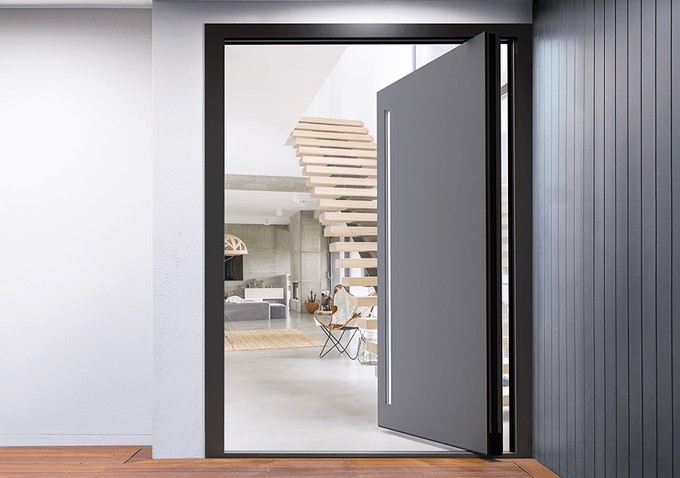
Source:https://camelglass.co.uk
First impressions are formed in seven seconds, but in the world of high-end corporate architecture, that impression is made before a visitor even speaks to a receptionist. Imagine walking up to a headquarters where the entrance isn’t just a barrier, but a five-hundred-pound slab of oak and steel that glides open with the touch of a single finger. It doesn’t swing; it rotates. It doesn’t just open; it performs.
In my decade of consulting on luxury home and office renovations, I’ve seen clients spend thousands on landscaping and lighting, only to settle for a standard “big box” entryway. To me, that’s like wearing a tailored tuxedo with plastic flip-flops. When we talk about a Pivot Front Door, we are talking about the ultimate statement piece in modern curb appeal. It is the architectural equivalent of a firm, confident handshake.
The Mechanics of Elegance: What Makes a Pivot Door Different?
To the uninitiated, a door is a door. But for those of us who live in the details, the Pivot Front Door represents a departure from centuries of traditional carpentry. Unlike a standard door that hangs from side-mounted hinges, a pivot door rotates on a vertical axis.
Think of a standard door like a page in a book, fixed firmly at the spine. A pivot door, by contrast, is more like a spinning top or a luxury turntable. The weight is supported by a heavy-duty pivot box recessed into the floor and a matching header at the top.
Because the weight is distributed vertically rather than pulling horizontally on a frame, we can design doors that are significantly larger, heavier, and more material-rich than anything a traditional hinge could ever support.
Architectural Harmony: Integrating the Pivot Front Door into Your Facade
When I design an entryway for a corporate or high-end residential client, I look for “architectural integration.” This means the door shouldn’t look like it was stuck onto the building; it should look like it was carved out of it.
1. Scale and Proportion
A Pivot Front Door thrives on “oversize” aesthetics. While a standard door is 36 inches wide, a pivot door starts feeling “right” at 48 to 60 inches. I’ve installed units that reach 10 feet in height. This scale communicates authority. If your facade features high ceilings or expansive glass, a small door will look like a mistake. The pivot system allows us to match the grand scale of the building itself.
2. Material Continuity
I often recommend using “cladded” pivot doors. We can use the same stone or metal siding from the exterior walls and apply it directly to the door’s surface. Because the pivot hardware is rated for hundreds (sometimes thousands) of pounds, the door can “disappear” into the wall when closed, creating a seamless, monolithic look that is incredibly popular in contemporary minimalist design.
Technical Deep-Dive: The Hardware and Engineering
For the intermediate enthusiast, the beauty of the Pivot Front Door is in the engineering. If you get the hardware wrong, you don’t have a door—you have a hazard.
-
Self-Closing Mechanisms: High-end systems often include hydraulic dampers. This ensures that even a 400-pound door closes softly and securely, preventing the “bank vault” slam that can rattle windows.
-
Weather Stripping and Sealing: Historically, pivot doors struggled with drafts. Modern systems utilize drop-down seals at the bottom and magnetic gaskets on the sides to ensure your HVAC efficiency isn’t flying out the door.
-
Threshold Management: In a corporate setting, ADA compliance is non-negotiable. We use recessed floor closers that sit flush with the flooring, allowing for a zero-transition entry that is safe for everyone while maintaining that clean architectural line.
Why the Pivot System is a Corporate Game Changer
In the corporate world, curb appeal translates to brand value. A Pivot Front Door suggests that the company inside is forward-thinking, values quality, and pays attention to the details.
-
Longevity: Traditional hinges eventually sag under the weight of heavy solid-core doors. A pivot system, by contrast, gets more stable as it gets heavier because the weight is being pushed directly into the floor.
-
Minimalist Hardware: Because the door stays closed via internal tension and hydraulic systems, we can use massive, vertical pull bars that add to the “verticality” of the building design.
-
Security: Most pivot doors are custom-built with steel-reinforced cores. When locked, they are virtually impossible to kick in or pry open compared to standard wood frames.
Expert Advice: Avoiding the “Pivot Pitfall”
Tips Pro: The Hidden Warning
The biggest mistake beginners make is ignoring the “back-swing.” Because the pivot point is usually offset by 4 to 12 inches from the side of the door, the back edge of the door actually swings inward as the front edge swings outward.
If you have a wall, a piece of furniture, or a light fixture too close to the hinge side, the door will hit it. Always calculate your “clearance zone” on both sides of the axis before you finalize your door width.
Installation Insights: A Professional’s Perspective
I remember a project in downtown Seattle where we were installing a custom copper-clad Pivot Front Door. The contractor hadn’t perfectly leveled the floor slab. In a standard door, you can shim the hinges. In a pivot door, if that floor box is off by even 1/8 of an inch, the entire 8-foot slab will look crooked against the frame.
Key Installation Steps:
-
Laser Leveling: Use a 360-degree laser to ensure the floor pivot and the top header are perfectly plumb.
-
Structural Headers: Ensure the ceiling can handle the “top-pin” pressure. Even though the floor carries the weight, the top of the door exerts lateral force.
-
The “Sweep” Check: Before the floor is finished, do a dry fit to ensure the door clears the floor through its entire arc.
Enhancing Sustainability and Energy Efficiency
Many of my clients ask if a Pivot Front Door is “green.” While large doors naturally lose more heat than small ones, the materials we use today—like thermally broken aluminum frames and insulated wood cores—drastically improve R-values. When you combine these with high-performance glass inserts (Low-E coatings), you can have a grand entrance that doesn’t ruin your energy audit.
Integrating a Pivot Front Door into a corporate or modern residential project is about more than just a way to enter a building; it’s about the transition from the outside world to a curated interior experience. It’s an investment in architectural integrity and a signal of premium quality.
If you are looking to elevate your property’s curb appeal, stop looking at standard catalogs. Think about the physics, the materials, and the statement you want to make.
Are you considering a pivot door for your next project? What material do you think best represents your brand—warm wood, industrial steel, or sleek glass? Share your thoughts or questions about installation challenges below! I’m here to help you navigate the technicalities of your next big entrance.