
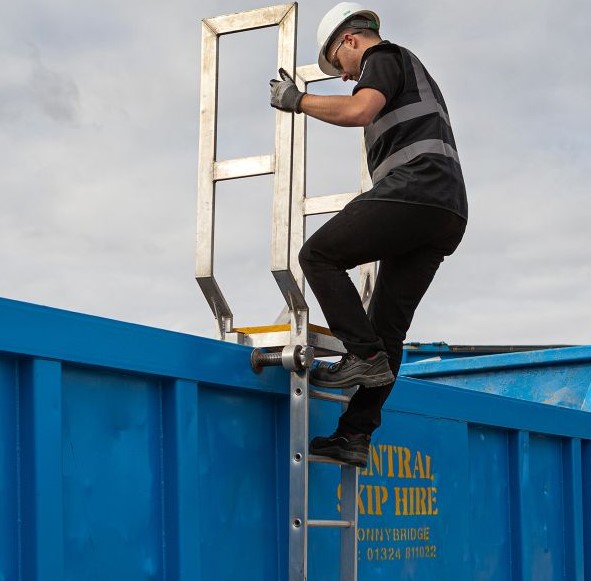
Source:https://www.solmha.com
You are standing on your tip-toes atop a rickety kitchen chair, reaching for a recessed light bulb that just flickered out. Your knees are wobbling, the chair is groaning, and for a split second, gravity feels like an impending threat. According to hospital safety data, ladder-related accidents account for over 160,000 emergency room visits annually in the U.S. alone—and a huge chunk of those happen because homeowners use the wrong tool for a “quick” task.
In my decade of navigating attic joists and hanging heavy crown molding, I’ve learned that a high-quality Step Ladder Folding system isn’t just a convenience; it’s your primary safety tether to the vertical world. It is the bridge between a project finished with a smile and a weekend spent in a cast.
The Evolution of Vertical Mobility
When I first started in the trades, ladders were heavy, wooden behemoths that left splinters in your palms and took two people to move. Today, we’ve entered an era of “operational flexibility.”
Modern engineering has transformed the humble ladder into a precision instrument. A Step Ladder Folding unit today is designed to be a “transformer” for your home—compact enough to hide behind a laundry room door, yet sturdy enough to support a 300-pound professional carrying a bucket of joint compound.
Technical Breakdown: Anatomy of a Pro-Grade Step Ladder Folding System
Choosing a ladder is like buying tires for your car. You don’t just want the ones that fit; you want the ones that won’t fail when the pressure is on. Here is what I look for when auditing a client’s workshop.
1. Duty Ratings and Load Capacity
Never overlook the sticker on the side of the rail. The American National Standards Institute (ANSI) categorizes ladders into “Types.”
-
Type IA (300 lbs) or Type IAA (375 lbs): These are my go-to. Even if you don’t weigh 300 lbs, the extra “stiffness” in the rails prevents the terrifying swaying sensation when you reach for a corner.
-
Type III (200 lbs): Avoid these for anything other than very light dusting. They lack the torsional rigidity required for actual home improvement.
2. Material Science: Aluminum vs. Fiberglass
This is the most frequent question I get.
-
Aluminum: Lightweight and corrosion-resistant. Perfect for painting, cleaning gutters, or general maintenance.
-
Fiberglass: This is non-negotiable if you are doing electrical work. Aluminum conducts electricity; fiberglass does not. If you are changing a ceiling fan or working near a circuit breaker, the fiberglass Step Ladder Folding is your life insurance policy.
3. Pinch-Proof Spreaders and Slip-Resistant Feet
Look for “pinch-proof” spreaders—the metal braces that lock the ladder open. Cheaper models have thin hinges that can bite your fingers during setup. High-end models use internal spreaders or recessed designs that are much safer for high-speed workflows.
Strategic Workflow: Why Folding Design Wins Every Time
Think of a folding ladder like a Swiss Army Knife for your height. A fixed-height ladder is great for one specific task, but a folding step ladder is a multi-tool.
The “Triangle of Stability”
In geometry and engineering, the triangle is the strongest shape. A Step Ladder Folding unit utilizes this principle to distribute your weight evenly across four points of contact. Unlike an extension ladder that leans against a wall (and can slide sideways), a step ladder is self-supporting. This allows you to work in the middle of a room—essential for light fixtures or ceiling repairs.
Storage Optimization
Space is a finite resource in most homes. The “folding” aspect allows for a profile as thin as 4 inches. I’ve seen homeowners maximize their “Operational Flexibility” by mounting their ladders on heavy-duty wall hooks in the garage, keeping the floor clear for larger power tools.
Expert Insight: The “Hidden” Dangers of the Top Step
There is a reason the top platform of a Step Ladder Folding unit usually has a big “NOT A STEP” warning.
Expert Advice: The Belt Buckle Rule
When you are on a ladder, keep your belt buckle between the two side rails at all times. The moment your buckle moves outside that frame, your center of gravity shifts, and the ladder becomes a catapult. Also, never stand on the top two rungs. If you can’t reach the target while standing three rungs from the top, you don’t need a better reach—you need a taller ladder.
Scaling Flexibility: Specialized Features for Intermediate Users
For those of you moving beyond basic bulb-changing into serious renovations, keep an eye out for these “Tier 2” features:
-
Integrated Project Trays: Many pro-grade folding ladders now feature “Holster Tops.” These have specific slots for screwdrivers, drill holsters, and paint cans. This prevents the “up-and-down” fatigue of climbing for every single screw.
-
Multi-Position Feet: Some high-end Step Ladder Folding models have adjustable legs for use on stairs. If you’ve ever tried to paint a stairwell, you know that a standard ladder is useless there.
-
LSI Keywords to Search: Torsional rigidity, spreader bars, rung depth, flared base, and non-conductive side rails.
Maintenance: Protecting Your Access Asset
A ladder is a mechanical tool, and it needs a “health check” once a year.
-
The Foot Check: Look at the rubber feet (shoes). If they are worn down to the metal, the ladder will slide on hardwood or tile like a hockey puck. You can buy replacement feet for most major brands.
-
The Rivet Inspection: Look for loose rivets or cracks in the fiberglass. If you see “stress whitening” (a pale mark on the plastic or metal), the structural integrity is compromised.
-
The Cleaning: Spilled paint isn’t just ugly; it can hide cracks in the rungs. Keep your Step Ladder Folding clean with a simple degreaser.
The ROI of Professional-Grade Access
From a Home Improvement Expert’s perspective, a $150 investment in a top-tier ladder pays for itself the first time you don’t fall. It speeds up your painting by 20%, makes gutter cleaning a 15-minute task instead of an hour-long ordeal, and gives you the confidence to tackle high-ceiling branding and lighting projects that would otherwise require hiring a contractor.
Conclusion: Reach Your Potential
Your home is a three-dimensional puzzle. To solve it, you need to be able to move vertically with total confidence. A Step Ladder Folding system is the most overlooked “power tool” in the garage, yet it is the one you will likely use more than your drill or your saw.
By understanding the technical duty ratings, choosing the right material for the job, and respecting the “Belt Buckle Rule,” you turn a potentially dangerous task into a streamlined, professional operation.
Have you ever had a “near-miss” on an old ladder? Or are you currently debating between an aluminum or fiberglass model for your next project? Let me know in the comments—I’d love to help you find the perfect height for your home!