
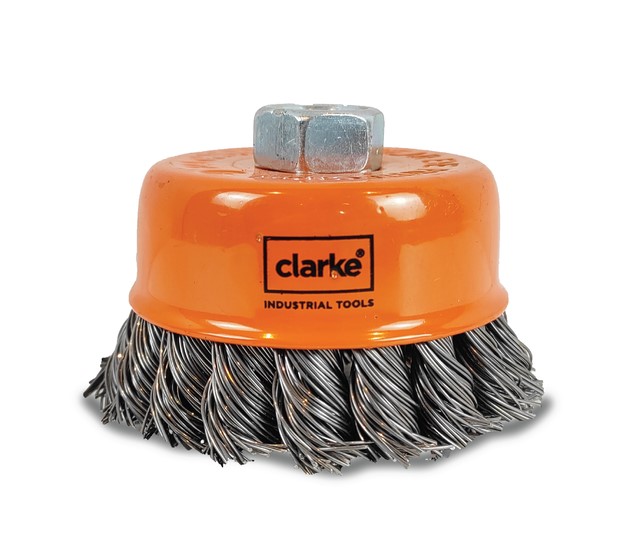
Source:https://clarkehandtools.com
A couple of years back, a client brought a vintage cast-iron fireplace mantel into my workshop. The previous owner had laid down four thick layers of oil-based paint, under which sat decades of surface rust. The client’s biggest fear? Gouging the detailed floral engravings underneath.
I watched a junior apprentice pick up an angle grinder fitted with a aggressive steel wire wheel. I stopped him just before he touched the metal. Steel wires on delicate or detailed metals are like taking a cheese grater to fine leather—you will strip the paint, but you will permanently ruin the underlying craftsmanship. Instead, we mounted a silicon-carbide-impregnated nylon cup brush onto the grinder. Within forty minutes, the paint peeled away smoothly, leaving the crisp cast-iron detail completely untouched.
That day was another reminder of a fundamental rule in surface prep: aggression does not equal efficiency.
Whether you are restoring metalwork, prepping hardwood for staining, or cleaning masonry, understanding how to utilize a nylon cup brush effectively will drastically elevate the quality and safety of your refinishing projects.
The Science of Abrasive Filaments: How Nylon Outperforms Steel
To understand why a nylon cup brush works so well without damaging base materials, think of traditional wire wheels like a collection of tiny, rigid chisels. Steel bristles scrape surfaces through force, which often leaves micro-scratches, heat marks, or flying wire shrapnel.
A nylon brush operates completely differently. It acts like a high-speed flexible file.
TRADITIONAL STEEL WIRE WHEEL
Metal Bristle ---> [ Scrapes Base Metal ] ---> Gouges & Micro-Scratching

ABRASIVE NYLON CUP BRUSH
Nylon Filament Matrix (Containing Silicon Carbide Grit)
             ---> [ Flexes Across Contour ] ---> Buffs Coating Away Safely
Each individual nylon bristle is embedded throughout its core with fine abrasive grains—typically Silicon Carbide (SiC) or Aluminum Oxide (Al2O3). As you operate the tool, the nylon tip wears down gradually, continually exposing fresh, sharp abrasive particles. The flexible nylon body conforms to uneven contours, radiused edges, and recessed details rather than gouging them flat.
Technical Comparison: Nylon vs. Wire vs. Flap Discs
When picking an attachment for your angle grinder or drill, choosing the wrong abrasive tool costs both time and money. Here is how a premium nylon cup brush stacked up against standard alternatives in our workshop testing:
| Performance Metric | Abrasive Nylon Cup Brush | Twisted Knotted Steel Wheel | Zirconia Flap Disc (Grit 80) |
| Primary Material | Nylon 6.12 + Silicon Carbide | High-Tensile Carbon Steel | Coated Abrasive Cloth |
| Substrate Safety | High (Does not gouge metal/wood) | Low (Prone to deep scoring) | Very Low (Removes base metal rapidly) |
| Conformability | Superior (Flexes into grooves) | Moderate (Rigid face) | Poor (Flat surface grinding only) |
| Rust Ingestion / Sparks | Zero Sparks / Non-Oxidizing | High Spark Output / Prone to Rusting | High Spark Output / High Dust |
| Grit Versatility | Coarse (80) to Fine (240+) | N/A (Wire diameter dependent) | Coarse (40) to Fine (120) |
| Average Lifespan | Long (Self-sharpening matrix) | Medium (Bristles fatigue and snap) | Short (Grit loads up quickly) |
Where the Nylon Cup Brush Excels: Key Applications
Over my decade in home improvement and custom fabrication, I’ve found four primary scenarios where this tool is unbeatable:
1. Architectural Wood Distressing & Grain Enhancement
If you want to create a rusticated, weathered timber look on softwoods like pine or cedar, a nylon cup brush mounted on a variable-speed grinder is magic. The flexible bristles sweep out the soft earlywood annual rings while leaving the hard latewood ridges intact, giving you an authentic 3D wood grain texture in minutes.
2. Non-Destructive Rust and Paint Stripping
Removing light oxidation, mill scale, or old finishes from aluminum, brass, or thin sheet metal demands precision. Because nylon filaments generate significantly less friction heat than steel, you avoid warping thin metals or melting underlying substrates.
3. Cleaning Textured Masonry and Concrete Joints
Cleaning efflorescence, moss, or dried mortar smears from brick walls or flagstone pathways quickly shreds paper sanding discs. A coarse-grit nylon cup brush conforms into porous grout lines without breaking down the surrounding mortar matrix.
Step-by-Step Field Guide for Best Results
Getting professional results with abrasive nylon isn’t just about turning on your power tool—it requires proper technique and speed control.
Step 1: Matching RPM to Filament Physics
The single biggest mistake beginners make is running a nylon cup brush at full speed on a standard single-speed angle grinder (which often spins at 11,000+ RPM). Excessive speed melts the nylon bristles onto your workpiece, leaving plastic smears that are a pain to clean.
-
Optimal Speed: Run your power tool between 2,500 RPM and 4,500 RPM.
-
Use a variable-speed angle grinder or a heavy-duty corded drill with an arbor adapter.
Step 2: Let the Abrasive Do the Work
Never press down hard on the tool. Heavy downward pressure bends the nylon bristles flat against the surface, rubbing the side of the bristle rather than the abrasive-rich tip. Apply light to moderate pressure—let the exposed abrasive tips lightly touch the material.
Step 3: Sweep Across Boundaries Systematically
Keep the brush moving continuously in overlapping, circular motions. Stationary dwelling will create uneven surface sheen or heat up localized spots unnecessarily.
       [Overlapping Circular Pass]
    (  ((   ((   ((   ((   ((   )  )
    +------------------------------+
    |    WORKPIECE SURFACE AREA    |
    +------------------------------+
Expert Advice: Critical Pro Tips & Field Warnings
Hidden Warning: Always double-check the directional thread or shank rating before mounting a nylon cup brush. Never exceed the Maximum Operating RPM stamped on the cup housing. Operating a brush rated for 4,500 RPM on an un-regulated 12,000 RPM grinder will cause the filaments to fling outward, disintegrate from thermal overload, and pose a severe eye safety hazard.
Here are four additional ground rules straight from my shop notes:
-
Prevent Cross-Contamination: Never use the same nylon cup brush on carbon steel and then take it directly to stainless steel or aluminum. Microscopic iron particles trapped in the nylon filaments can transfer to the non-ferrous metal, causing unexpected surface rust spots later on.
-
Match Grit to Purpose: Use 80-grit (Coarse/Grey-Black) for heavy scale or paint removal; use 120-grit to 240-grit (Medium to Fine/Red or Blue) for fine metal finishing, surface blending, or light denibbing.
-
Wear Personal Protective Equipment (PPE): Even though nylon is safer than flying steel wires, microscopic abrasive particles and removed coatings will become airborne dust. Always wear full-seal safety goggles, a P95/N95 dust respirator, and tight-fitting work gloves.
-
Dress the Brush Periodically: If the filament tips get glazed with melted paint or sap, run the spinning brush briefly against a scrap block of rough 60-grit concrete block to clean the tips and expose fresh abrasive grit.
Elevate Your Surface Prep Technique
Refinishing surfaces doesn’t mean you have to blast away your base material with aggressive metal wheels or chemical strippers. By incorporating a high-durability nylon cup brush into your tool kit, you achieve a level of precision, safety, and surface finish quality that traditional wire brushes simply cannot match.
What surface prep or restoration challenge are you working on right now? Have you tried switching from traditional steel wheels to abrasive nylon? Leave a comment below with your questions or setup details—I’d be glad to share technical insights for your specific project!