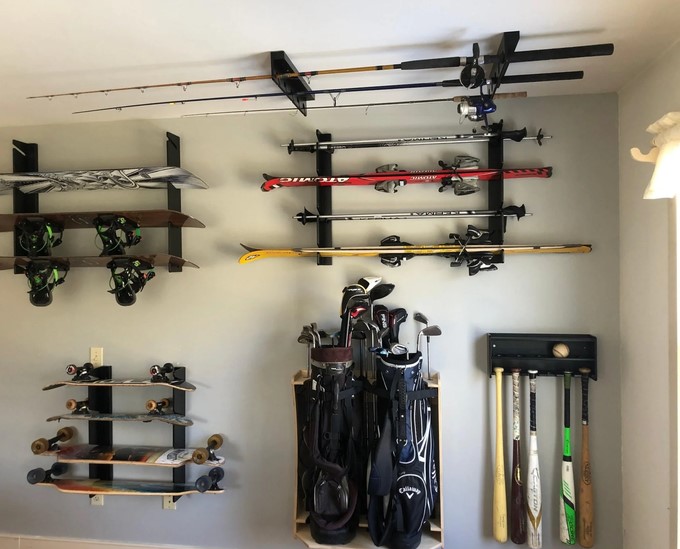
Source:https://hangthisup.com
There is nothing quite as frustrating as heading out for a 5:00 AM fishing trip, reaching into a chaotic garage corner, and pulling out a tangled, bird’s-nest cluster of graphite rods—only to hear the sickening snap of a sensitive rod tip as it catches on a lawnmower handle or a stray rake.
I witnessed this firsthand a few seasons back while helping a client overhaul his cluttered two-car garage. Tucked behind his lawn equipment were five high-end carbon fiber casting rods worth over $1,200. Three of them were severely bent from being leaned against a hot concrete wall, and two had cracked guide rings from accidental bumps.
He didn’t need new fishing tackle; he needed a dedicated wall-mounted storage system.
Within an afternoon, we installed a heavy-duty garage fishing rod rack overhead, elevating his delicate blanks safely out of harm’s way. Over my 10+ years in residential organization and custom garage builds, I’ve learned that specialized equipment storage isn’t a luxury—it is essential preventative maintenance for high-value gear.
The Materials Science of Rod Damage: Why Corners Kill Carbon Fiber
To understand why custom storage is necessary, you have to look at how modern fishing rods are manufactured.
High-performance rods are engineered from thin-walled composite blanks of high-modulus carbon fiber or matrix fiberglass. They are designed to absorb immense tensile flexing along their structural curve when fighting a fish, but they are surprisingly vulnerable to localized transverse impacts and static stress.
When you lean a sensitive fishing rod against a garage wall at a 45-degree angle for months at a time, continuous gravitational force creates a permanent structural set or bend in the blank.
Combine that with constant garage temperature swings and humidity changes, and the epoxy resin binding the carbon fibers degrades. Installing a proper garage fishing rod rack cradles the blank uniformly, keeping the spine completely straight and stress-free.
+--------------------------+-----------------------+-----------------------+-------------------------+
| Storage Orientation Type | Space Efficiency      | Protection Level      | Best Application        |
+--------------------------+-----------------------+-----------------------+-------------------------+
| Vertical Wall Mount      | Moderate (Uses Wall)  | High (Snag-Free)      | Daily Use / Quick Access|
| Overhead Ceiling Mount   | Maximum (Zero Footprint)| Exceptional         | Long-Term / High Ceiling|
| Free-Standing Floor Rack | Low (Takes Floor Space)| Moderate (Vulnerable) | Display / Tackleroom   |
| Horizontal Wall Track    | High                  | High                  | Long Surf / Fly Rods    |
+--------------------------+-----------------------+-----------------------+-------------------------+
Evaluating Rack Architectures: Ceiling vs. Wall Systems
When selecting or building a storage rack for your garage, your decision comes down to two primary structural layouts: Vertical Wall Racks and Overhead Ceiling Systems.
1. Vertical Wall-Mounted Racks
Ideal for garages with available wall real estate. These systems feature a bottom notch or cup track to cradle the rod butts, paired with soft rubber or high-density EVA foam clips along the upper rail to hold the rod blanks securely without scratching the finish.
2. Overhead Ceiling Racks (The Space Maximizer)
If your garage walls are already filled with cabinets, pegboards, or lawn tool tracks, look up! The unused air space above your garage door or between exposed ceiling joists is prime real estate. Horizontal overhead tracks keep long 7-foot to 10-foot rods completely out of traffic zones while utilizing zero floor space.
Ergonomics and Environmental Protection in Garage Environments
Garages are tough environments for delicate gear. Dust, vehicular exhaust, direct sunlight, and heat pockets all work against sensitive equipment.
-
UV Degradation: Avoid mounting your garage fishing rod rack directly opposite a south-facing window or transparent garage door panel. Sunlight breaks down clear-coat epoxies and embrittles monofilament lines over time.
-
Corrosion Control: Fluorocarbon and braided lines don’t rust, but the stainless steel or titanium guide frames, line rollers, and reel seats certainly can if exposed to damp air. Keep your storage area well-ventilated and dry.
Step-by-Step Installation Protocol for Overhead Ceiling Racks
Mounting a ceiling rack safely requires anchoring directly into solid structural ceiling joists. Never rely on drywall anchors for overhead equipment storage!
Expert Advice: Pro Tips and Hidden Traps
⚠️ The Drag Washer Compression Trap
The most costly mistake anglers make when putting their gear onto a garage fishing rod rack for the off-season is leaving the fishing reel drag tightened down completely! Storing reels under high drag tension compresses the carbon fiber or felt drag washers permanently, ruining their smooth operation. Always back off your reel drag knobs entirely before racking your rods for long-term storage.
Protecting Guide Inserts
The thin ceramic or silicon carbide (SiC) inner rings inside your rod guides are extremely hard but brittle.
When loading rods onto metal or hard plastic rack hooks, accidental contact can chip or crack the ceramic ring. Once cracked, that sharp ceramic edge will slice through your fishing line under tension like a razor blade! Opt for racks lined with soft rubber grommets, neoprene, or smooth HDPE plastics.
💡 Pro Tip from the Field
Before storing your setup for the winter, strip off any old, salt-encrusted line and wipe down the rod blank and guides with a soft micro-fiber cloth sprayed with a light coat of marine-grade silicone spray or furniture polish. This leaves a hydrophobic protective barrier that repels ambient humidity, prevents guide oxidation, and keeps your gear looking brand new for years.
Elevate Your Gear Management Strategy
Protecting your sporting assets doesn’t require complex engineering, but it does demand a systematic approach. Installing a rugged, space-efficient garage fishing rod rack preserves the structural integrity of your carbon blanks, protects ceramic guide inserts, and transforms a cluttered garage floor into an organized, functional space.
How do you currently store your fishing rods and specialized gear in your garage? Have you ever suffered a snapped rod tip or damaged reel due to improper storage? Drop a comment below with your questions or share your favorite garage organization hacks—I’d love to hear your thoughts!