
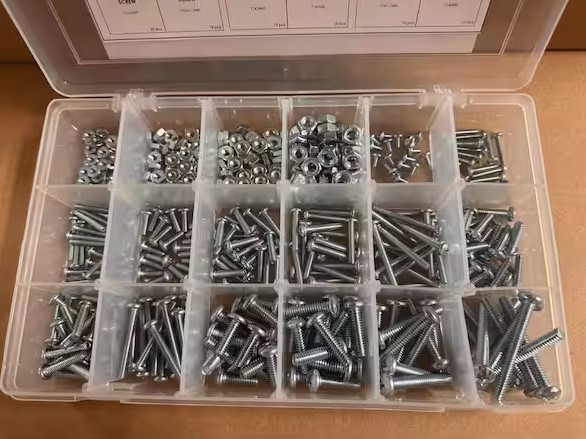
Source:https://images.thdstatic.com
A few months ago, I was called in to troubleshoot a failed HVAC installation at a commercial residential property. The main air handler unit was vibrating violently against its mounting bracket, producing an intolerable rattling noise throughout the second floor.
When I took off the access panel, the issue was immediately clear: the previous installer had forced a coarse-thread wood screw into a pre-tapped metric metal flange. He had stripped the internal threads completely, leaving the heavy motor housing held together by sheer luck and a prayer.
I spent twenty minutes re-tapping the stripped hole and pulling out a precise M6 stainless steel bolt from my organized machine screw kit. In under five minutes, the unit was bolted down solid as a rock, whisper-quiet, and fully restored.
Over my 10+ years in home improvement and mechanical contracting, I’ve seen thousands of dollars lost to stripped threads, mismatched fasteners, and wasted trips to the hardware store. Owning a well-curated machine screw kit isn’t just about collecting spare hardware—it is a foundational system for standardized repair, operational efficiency, and long-term structural reliability.
Machine Screws vs. Wood Screws: The Physics of Fastening
To understand why a dedicated machine screw kit is irreplaceable, you must understand how different fasteners transfer mechanical force.
Think of a standard wood screw or drywall screw like a wedge driven into a piece of wood. It cuts its own path, creating friction by displacing and compressing surrounding material.
A machine screw, by contrast, behaves like a precision-engineered micro-vise. It does not cut its own hole. Instead, its uniform, parallel metal threads mesh smoothly into pre-tapped internal threads or pair with a matching hex nut. This creates uniform clamping force across the joined materials without deforming or weakening the substrate.
+--------------------------+-----------------------+-----------------------+-------------------------+
| Fastener Attribute       | Standard Wood Screw   | Sheet Metal Screw     | Machine Screw           |
+--------------------------+-----------------------+-----------------------+-------------------------+
| Thread Type              | Coarse, Tapered       | Sharp, Self-Tapping   | Fine/Coarse Parallel    |
| Required Mating Surface  | Raw Wood / Anchor     | Thin Metal Sheet      | Pre-Tapped Hole or Nut  |
| Primary Stress Bearing   | Material Shear / Friction| Material Friction  | High Clamping Force     |
| Reusability / Lifecycle  | Low (Wears Material)  | Moderate              | Infinite (Non-Stripping)|
+--------------------------+-----------------------+-----------------------+-------------------------+
Navigating Thread Standards: Imperial (SAE) vs. Metric Systems
The biggest headache DIYers and intermediate maintainers face is cross-threading mixed fasteners. A quality machine screw kit solves this by keeping thread standards strictly organized.
1. Imperial / Unified Thread Standard (UTS)
In North America, imperial machine screws are designated by gauge size, nominal diameter, and thread pitch (e.g., #8-32 x 1″ or 1/4″-20 x 1/2″):
-
#8: Specifies the diameter gauge size.
-
32: Represents the thread count per inch (TPI).
-
1″: Denotes the overall shank length under the screw head.
2. Metric System (ISO)
Metric fasteners use a simple, streamlined measurement system (e.g., M4-0.7 x 20mm):
-
M4: Indicates a 4mm nominal outer diameter.
-
0.7: Measures the thread pitch—the actual distance in millimeters between adjacent thread peaks.
-
20mm: Specifies the shank length in millimeters.
Anatomy of a Pro-Grade Machine Screw Kit
If you buy a cheap bin of unsorted screws, you will waste more time digging for hardware than fixing things. A high-efficiency machine screw kit must be structured around specific technical criteria.
Material Grade and Metallurgy
-
304 / 316 Stainless Steel: Excellent corrosion resistance for outdoor fixtures, bathrooms, and plumbing repairs.
-
Grade 8 / Class 10.9 Alloy Steel: High tensile strength designed for heavy mechanical loads, structural brackets, and motor mounts.
-
Zinc-Plated Carbon Steel: Cost-effective indoor hardware suitable for appliances and electrical enclosures.
Essential Head Styles and Drives
A versatile kit should offer a mix of Pan Head (flat bottom for maximum surface contact), Countersunk Flat Head (flush seating), and Socket Cap (high-torque hex drive). Pair these with Phillips, Torx (Star), or Internal Hex drives to minimize cam-out risks.
Step-by-Step Protocol for Precision Fastening
Installing machine screws correctly ensures maximum clamping force and prevents stripped threads or frozen hardware down the road.
Expert Advice: Pro Tips and Hidden Traps
⚠️ Galvanic Corrosion Hazards
Never drive an unprotected carbon steel machine screw directly into an aluminum housing in damp or wet environments! Mixing dissimilar metals triggers galvanic corrosion, which fuses the screw permanently into the hole, seizing the threads. Always use stainless steel hardware with anti-seize lubricant when joining aluminum assemblies.
The Power of Matching Nuts and Flat Washers
A machine screw is only half of a fastening system. Always pair your screws with matching flat washers and nylon-insert lock nuts (Nyloc) from your kit. Flat washers distribute the clamping load evenly across fragile surfaces like plastic or sheet metal, while nylon lock nuts keep assemblies tightly bound without backing out over time.
💡 Pro Tip from the Field
Have a machine screw that is slightly too long for a blind hole? Thread a standard hex nut onto the screw shank first, cut the screw down to your desired length with a hacksaw or rotary tool, and then unscrew the nut. As the nut backs off the end, it automatically straightens and dresses the freshly cut metal threads!
Streamline Your Maintenance Operations Today
Standardizing your hardware inventory with a high-durability, well-organized machine screw kit is an essential milestone for any serious DIYer, home improver, or technician. By respecting thread pitch physics, using the correct metallurgy, and following precise torque protocols, you eliminate costly repair delays and ensure your household fixtures remain rock-solid for life.
How do you currently organize and manage your spare fasteners and hardware inventory? Have you ever dealt with the nightmare of a stripped thread on a critical home appliance or mechanical project? Drop a comment below with your questions or share your favorite shop organization hacks—I’d love to jump into the discussion!